



- Voice
- Keyboard
- String
- Woodwind
- Brass



 - )


N°1 Schwanenlied
1840
Harp + Various instruments
Arranged by Frédéric CELLIER
Duration ≃ 01:55
 Ajouter
SCORE Bassoon and piano or harp
PDF - 4 pages
PART Bassoon
PDF - 2 pages
 Ajouter
SCORE Cello and piano or harp
PDF - 4 pages
PART Cello
PDF - 2 pages
 Ajouter
SCORE Clarinet Bb (chalumeau) and piano or harp
PDF - 4 pages
PART Clarinet Bb (chalumeau)
PDF - 2 pages
 Ajouter
SCORE Clarinet Bb and piano or harp
PDF - 4 pages
PART Clarinet Bb
PDF - 2 pages
 Ajouter
SCORE Double bass and piano or harp
PDF - 4 pages
PART Double bass
PDF - 2 pages
 Ajouter
SCORE English horn and piano or harp
PDF - 4 pages
PART English horn
PDF - 2 pages
 Ajouter
SCORE Flute and piano or harp
PDF - 4 pages
PART Flute
PDF - 2 pages
 Ajouter
SCORE French horn F and piano or harp
PDF - 4 pages
PART French horn F
PDF - 2 pages
 Ajouter
SCORE Mandolin and piano or harp
PDF - 4 pages
PART Mandolin
PDF - 2 pages
 Ajouter
SCORE Oboe and piano or harp
PDF - 4 pages
PART Oboe
PDF - 2 pages
 Ajouter
SCORE Recorder Soprano or Tenor and piano or harp
PDF - 4 pages
PART Recorder Soprano or Tenor
PDF - 2 pages
 Ajouter
SCORE Saxophone Bb and piano or harp
PDF - 4 pages
PART Saxophone Bb
PDF - 2 pages
 Ajouter
SCORE Saxophone Eb and piano or harp
PDF - 4 pages
PART Saxophone Eb
PDF - 2 pages
 Ajouter
SCORE Trombone and piano or harp
PDF - 4 pages
PART Trombone
PDF - 2 pages
 Ajouter
SCORE Trumpet Bb and piano or harp
PDF - 4 pages
PART Trumpet Bb
PDF - 2 pages
 Ajouter
SCORE Trumpet C and piano or harp
PDF - 4 pages
PART Trumpet C
PDF - 2 pages
 Ajouter
SCORE Vibraphone and piano or harp
PDF - 4 pages
PART Vibraphone
PDF - 2 pages
 Ajouter
SCORE Viola and piano or harp
PDF - 4 pages
PART Viola
PDF - 2 pages
 Ajouter
SCORE Violin and piano or harp
PDF - 4 pages
PART Violin
PDF - 2 pages
 Ajouter
SCORE Voice and piano or harp
PDF - 4 pages
PART Voice
PDF - 2 pages
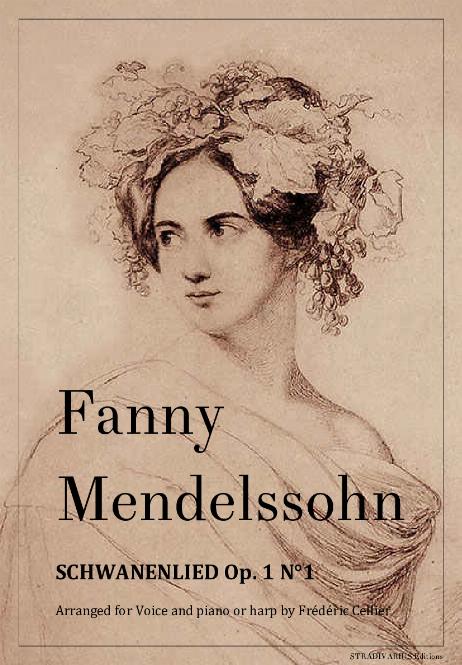
On September 4, 1839, Fanny Mendelssohn left Leipzig for Italy with her husband, the painter Wilhelm Hensel, and their nine-year-old son Sebastian. The family stayed in Rome for more than six months, where Fanny met the French composers Hector Berlioz and Charles Gounod, whom she greatly impressed. Gounod described her as “an unforgettable musician, a remarkable pianist, and a woman of superior intelligence.”
It was during this long stay in Rome that Fanny Hensel composed Schwanenlied, one of five songs written during the trip. This work also marks her last setting of a poem by Heinrich Heine (1797–1856). Although she knew the poet personally—a familiar figure in the Mendelssohns' intellectual circle—Fanny had little sympathy for him, finding him rather egocentric. Nevertheless, she deeply admired his poetry, as evidenced by the seventeen poems by Heine that she set to music, or nearly thirty if we include duets and vocal works for several voices.
The poem “Es fällt ein Stern herunter” also known as “Schwanenlied” is taken from the collection Buch der Lieder (1827):
Es fällt ein Stern herunter
Aus seiner funkelnden Höh,
Das ist der Stern der Liebe,
Den ich dort fallen seh.
Es fallen vom Apfelbaume,
Der weissen Blätter so viel,
Es kommen die neckenden Lüfte,
Und treiben damit ihr Spiel.
Es singt der Schwan im Weiher,
Und rudert auf und ab,
Und immer leiser singend,
Taucht er ins Flutengrab.
Es ist so still und dunkel,
Verweht ist Blatt und Blüt’,
Der Stern ist knisternd zerstoben,
Verklungen das Schwanenlied.
[A star falls from its sparkling height,
That is the star of love,
Which I see falling there.
So many white leaves fall from the apple tree,
The teasing winds come,
And play their game with them.
The swan sings in the pond,
The swan sings in the pond,
And rows up and down,
And singing ever more softly,
It dives into the watery grave.
It is so quiet and dark,
Leaves and blossoms are blown away,
The star has crackled and scattered,
The swan's song has faded away.]
In her composition, Fanny Hensel groups the four stanzas of the poem into two sections, followed by a brief postlude. The heart of the second stanza is marked by the sustained repetition of the word Flütengrab, which underscores the tragic end of the swan after its carefree swimming and singing. The piano accompaniment, animated by rapid sixteenth notes, evokes in turn the breeze, the rustling of leaves, the lapping of water, and the gliding of the bird. The vocal line gradually accompanies this decline, while the choice of a minor key accentuates the melancholy of the text.
Since ancient Greek times, legend has it that swans sing only once in their lives, when they sense their death approaching, offering a song of sublime beauty.
It was not until 1846, under the number Opus 1, that Fanny found the moral strength to publish Schwanenlied, but under the name Fanny Hensel, no doubt so as not to offend her family, who were opposed to her career as a composer.
This publication, which came a year before her death, was also the very first of her works.
Frédéric Cellier
Along his university studies (DEA in musicology, University of Paris IV-Sorbonne), Frédéric Cellier was awarded three first prizes and a development prize at the CNR of Nice and won first prize at the International Competition of Musical Execution - soloist category – of Stresa (Italy).
He is the laureate of the Fondation de France and the Yehudi Menuhin Foundation and accredited teacher at the CNR of Nice, the CNR of Marseille, and at the CRR Olivier Messiaen of Avignon (France).
Frédéric Cellier is the interpreter of Francis Poulenc’s Sonata for clarinet Bb and piano with Jean-Michel Damase, Jean Françaix or Gabriel Tacchino, as well as his own arrangements for clarinet and harp of Erik Satie's Gymnopédies and Gnossiennes with the great French harpist Elizabeth Fontan-Binoche, and for clarinet, piano, and string orchestra of George Gershwin's Rhapsody in blue for Wynton Marsalis or under the baton of Adrian Gershwin, grandson of the composer.
Founder and artistic director of STRADIVARIUS Editions, he is the author of light music pieces played around the world and a considerable number of arrangements of all styles and for all instruments, acclaimed by many personalities in the music world, including Michèle Auric, Jean Françaix, Adrian Gershwin, Wynton Marsalis, Yehudi Menuhin, Madeleine Milhaud, Manuel Rosenthal, Gabriel Tacchino, and Ornella Volta.
"Frédéric Cellier has produced a number of adaptations of Georges Auric's works with such talent and precision that I consider them a natural addition to his chamber music catalogue."
Michèle AURIC - Georges Auric's widow
"To Frédéric Cellier, excellent musician and tireless arranger."
Jean FRANÇAIX - Composer and pianist
"Arranging a musical work is always a delicate and risky exercise, because it requires both modifying it so that it can be played by the desired instruments and preserving its very essence. But that is exactly what Frédéric Cellier has done, preserving the nuances, subtleties and soul of the original works while breathing new life into them.
His arrangements give all the musicians the chance to perform these compositions specially revisited for their instrument, and make music lovers rediscover them in a new light."
Adrian GERSHWIN - George Gershwin’s grandson
"Congratulations for your beautiful new orchestration and rendition of Gershwin’s Rhapsody in blue."
Wynton MARSALIS - Trumpet player, composer, bandleader, general and artistic director of Jazz at Lincoln Center, New York
"It is outstanding that Frédéric Cellier has managed to transpose Saxophone Marmalade from the saxophone to the clarinet. I thank him for it and wish its great and deserved success. "
Manuel ROSENTHAL - Conductor, composer and Maurice Ravel’s pupil
"I am very happy to tell you how much I appreciated your transcription of the Capriccio, based on Francis Poulenc's Le Bal Masqué. It perfectly reflects the spirit and verve of the score for two pianos that I had the opportunity to play and record with Jacques Février, and it was a great pleasure for me to premiere it in Montpellier."
Gabriel TACCHINO - Pianist, Francis Poulenc’s specialist
"I must tell you that I really like your transcriptions and that I think the tone of the instruments you have chosen suits perfectly our beloved composer."
Ornella VOLTA - Musicologist, president of the Erik Satie’s Foundation


Added to your basket
Removed from your basket
Added to your favorites
Removed from your favorites
You must be registered to use this function
You reached the download limit for free products (5 per day)