



- Voice
- Keyboard
- String
- Woodwind
- Brass
 $ 1.99


 - SCORE Clarinet solo)



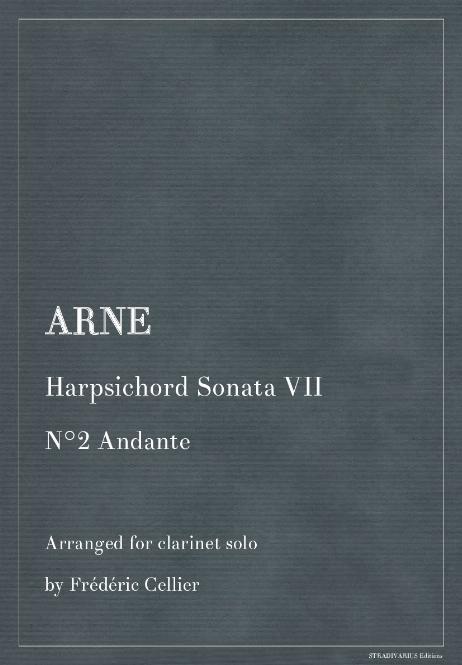
N°58 Menuet KV 2
1762
Clarinet solo
Arranged by Frédéric CELLIER
Duration ≃ 01:05 | Difficulty ≃ 3/10
$ 1.99 Add
Add
SCORE Clarinet solo
PDF - 1 page
"Melody is the essence of music" - Wolfgang Amadeus Mozart.
For the majority of instrumentalists, chamber music or orchestral experiences are only occasional experiments, while solitary study constitutes the essential part of their musical activity.
This daily practice cannot be reduced to repetitive technical preparation based solely on the study of scales and arpeggios, otherwise it becomes mechanical, draining and demotivating. The musician's instrumental as well as intellectual and artistic qualities must be able to be exercised and to flourish on the basis of high-quality musical content, drawn from a repertoire that is stylistically as varied as possible, and that is both demanding and inspiring.
In this respect, it seems not only legitimate but advisable for all instrumentalists - including those playing a monodic instrument - to perform musical masterpieces in order to discover them and gain an in-depth knowledge of them.
This appropriation necessarily involves arranging, which has its flaws and weaknesses, but which is the only way to expand limited repertoires. While some works are easily adapted by simple re-instrumentation, the same cannot be said of many others, which require greater skill and daring. For example, it's an ambitious bet to try to capture the essence of a reduced polyphonic piece, 'arranged' into a simple melodic line. But it's well worth it, because the result is not only undeniable instrumental and cultural enrichment but also, and above all, musical pleasure for the performer.
Frédéric Cellier, arranger
Wolfgang Amadeus Mozart was born on January 27, 1756, in Salzburg, Austria. His father, Leopold Mozart, a renowned violinist and composer, introduced him to composition and the keyboard at an early age. A child prodigy, Wolfgang showed extraordinary abilities from the age of five: he composed, played the piano and violin with rare virtuosity, and performed before the royal courts of Europe, impressing nobles and musicians alike with his musical maturity and extraordinary abilities.
Mozart traveled throughout Europe with his family, absorbing the influences of each region: the Italian style of opera, the German rigor of counterpoint, and French harmonic innovations. These experiences nourished his creativity and forged a style that was clear, elegant, and expressive, combining melodic finesse, mastery of form, and emotional depth. His compositions cover all genres: symphonies, concertos, operas, chamber music, and sacred works. Each piece illustrates his ability to combine beauty, balance, and dramatic intensity.
Among his masterpieces are the operas “The Marriage of Figaro,” “Don Giovanni,” and “The Magic Flute,” in which Mozart excels in the art of conveying the characters' personalities and emotions through music. His symphonies and concertos reveal a formal virtuosity and harmonic inventiveness that have had a lasting influence on Western music. Even in his lighter instrumental works, his ability to create memorable melodic lines and balanced structures is a testament to his genius.
Mozart led a life marked by intense creative activity, but also by recurring financial difficulties. He died prematurely in Vienna on December 5, 1791, at the age of 35, leaving behind a monumental body of work of exceptional richness.
Along with Haydn and Beethoven, he brought the achievements of the Viennese Classical school to their peak.
Along his university studies (DEA in musicology, University of Paris IV-Sorbonne), Frédéric Cellier was awarded three first prizes and a development prize at the CNR of Nice and won first prize at the International Competition of Musical Execution - soloist category – of Stresa (Italy).
He is the laureate of the Fondation de France and the Yehudi Menuhin Foundation and accredited teacher at the CNR of Nice, the CNR of Marseille, and at the CRR Olivier Messiaen of Avignon (France).
Frédéric Cellier is the interpreter of Francis Poulenc’s Sonata for clarinet Bb and piano with Jean-Michel Damase, Jean Françaix or Gabriel Tacchino, as well as his own arrangements for clarinet and harp of Erik Satie's Gymnopédies and Gnossiennes with the great French harpist Elizabeth Fontan-Binoche, and for clarinet, piano, and string orchestra of George Gershwin's Rhapsody in blue for Wynton Marsalis or under the baton of Adrian Gershwin, grandson of the composer.
Founder and artistic director of STRADIVARIUS Editions, he is the author of light music pieces played around the world and a considerable number of arrangements of all styles and for all instruments, acclaimed by many personalities in the music world, including Michèle Auric, Jean Françaix, Adrian Gershwin, Wynton Marsalis, Yehudi Menuhin, Madeleine Milhaud, Manuel Rosenthal, Gabriel Tacchino, and Ornella Volta.
"Frédéric Cellier has produced a number of adaptations of Georges Auric's works with such talent and precision that I consider them a natural addition to his chamber music catalogue."
Michèle AURIC - Georges Auric's widow
"To Frédéric Cellier, excellent musician and tireless arranger."
Jean FRANÇAIX - Composer and pianist
"Arranging a musical work is always a delicate and risky exercise, because it requires both modifying it so that it can be played by the desired instruments and preserving its very essence. But that is exactly what Frédéric Cellier has done, preserving the nuances, subtleties and soul of the original works while breathing new life into them.
His arrangements give all the musicians the chance to perform these compositions specially revisited for their instrument, and make music lovers rediscover them in a new light."
Adrian GERSHWIN - George Gershwin’s grandson
"Congratulations for your beautiful new orchestration and rendition of Gershwin’s Rhapsody in blue."
Wynton MARSALIS - Trumpet player, composer, bandleader, general and artistic director of Jazz at Lincoln Center, New York
"It is outstanding that Frédéric Cellier has managed to transpose Saxophone Marmalade from the saxophone to the clarinet. I thank him for it and wish its great and deserved success. "
Manuel ROSENTHAL - Conductor, composer and Maurice Ravel’s pupil
"I am very happy to tell you how much I appreciated your transcription of the Capriccio, based on Francis Poulenc's Le Bal Masqué. It perfectly reflects the spirit and verve of the score for two pianos that I had the opportunity to play and record with Jacques Février, and it was a great pleasure for me to premiere it in Montpellier."
Gabriel TACCHINO - Pianist, Francis Poulenc’s specialist
"I must tell you that I really like your transcriptions and that I think the tone of the instruments you have chosen suits perfectly our beloved composer."
Ornella VOLTA - Musicologist, president of the Erik Satie’s Foundation


Added to your basket
Removed from your basket
Added to your favorites
Removed from your favorites
You must be registered to use this function
You reached the download limit for free products (5 per day)