



- Voice
- Keyboard
- String
- Woodwind
- Brass
 $ 1.99


 - SCORE 2 Clarinets)



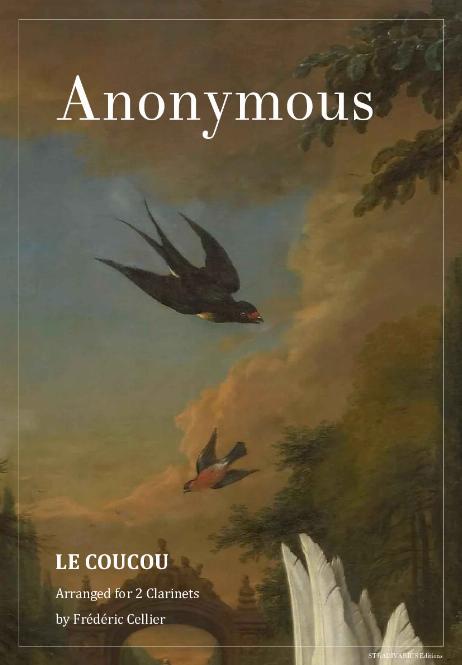
L'Aimable
1740
2 Clarinets
Arranged by Frédéric CELLIER
Duration ≃ 01:55 | Difficulty ≃ 3/10
$ 1.99 Add
Add
SCORE 2 Clarinets
PDF - 3 pages
Esprit Philippe Chédeville, known as Chédeville the elder, was a composer, oboist, court musette player and musical instrument maker from the prestigious Chédeville-Hotteterre family of French musicians.
His duties as virtuoso oboist and musette player at the Grande Écurie and the Court Chamber left him enough time to devote to his pupils, for whom he composed several series of pieces, including the ‘Duos Galants pour deux musettes, vièles et autres instruments’, which date from 1740.
These pieces are simple, varied and surprisingly attractive given the limited resources available to a composer with a simple duo of monodic instruments. Pastoral in tone, they offer a fine example of Baroque writing in which harmonisation in thirds alternates with counterpoint, and are embellished with delightfully evocative titles.
Esprit Philippe Chédeville, known as Chédeville the Elder, was born in 1696 in Oulins, France, into a family of musicians closely linked to the famous Hotteterre dynasty, renowned instrument makers and instrumentalists at the Parisian court. Immersed in this musical world from an early age, he trained in wind instruments and became a virtuoso of the court musette and oboe, two instruments emblematic of French Baroque pastoral music.
Admitted at the age of thirteen as a musician at the Paris Opera in 1709, Chédeville developed a refined musical practice that quickly led him to prestigious positions. Later, in May 1723, he was appointed musical director to Jean IV Hotteterre, oboist to the King's Chamber, confirming his place among the most esteemed instrumentalists on the Parisian scene.
Until his retirement from the Opera in 1736, Chédeville devoted himself not only to his role as a court musician—often in parallel with his duties at the Royal Chamber and the Royal Stables—but also to teaching and composition. He wrote numerous pieces for musette, hurdy-gurdy, and other wind instruments, often in the “gallant” or rustic style in vogue at the time. He published duets, suites, and Christmas carols that reflect a light, melodic aesthetic suited to pastoral instrumentation, which was favored in aristocratic salons and musical entertainment.
Alongside his work as a composer, Chédeville distinguished himself as an instrument maker: his richly decorated musettes were highly prized in musical and aristocratic circles, and he obtained publishing privileges for his own works.
Esprit Philippe Chédeville died in Paris in 1762, after a long career in the service of court music. Today, his works—rediscovered in particular in collections of Christmas carols and duos galants—continue to be performed for their charm and their typically French character of the Baroque era.
Along his university studies (DEA in musicology, University of Paris IV-Sorbonne), Frédéric Cellier was awarded three first prizes and a development prize at the CNR of Nice and won first prize at the International Competition of Musical Execution - soloist category – of Stresa (Italy).
He is the laureate of the Fondation de France and the Yehudi Menuhin Foundation and accredited teacher at the CNR of Nice, the CNR of Marseille, and at the CRR Olivier Messiaen of Avignon (France).
Frédéric Cellier is the interpreter of Francis Poulenc’s Sonata for clarinet Bb and piano with Jean-Michel Damase, Jean Françaix or Gabriel Tacchino, as well as his own arrangements for clarinet and harp of Erik Satie's Gymnopédies and Gnossiennes with the great French harpist Elizabeth Fontan-Binoche, and for clarinet, piano, and string orchestra of George Gershwin's Rhapsody in blue for Wynton Marsalis or under the baton of Adrian Gershwin, grandson of the composer.
Founder and artistic director of STRADIVARIUS Editions, he is the author of light music pieces played around the world and a considerable number of arrangements of all styles and for all instruments, acclaimed by many personalities in the music world, including Michèle Auric, Jean Françaix, Adrian Gershwin, Wynton Marsalis, Yehudi Menuhin, Madeleine Milhaud, Manuel Rosenthal, Gabriel Tacchino, and Ornella Volta.
"Frédéric Cellier has produced a number of adaptations of Georges Auric's works with such talent and precision that I consider them a natural addition to his chamber music catalogue."
Michèle AURIC - Georges Auric's widow
"To Frédéric Cellier, excellent musician and tireless arranger."
Jean FRANÇAIX - Composer and pianist
"Arranging a musical work is always a delicate and risky exercise, because it requires both modifying it so that it can be played by the desired instruments and preserving its very essence. But that is exactly what Frédéric Cellier has done, preserving the nuances, subtleties and soul of the original works while breathing new life into them.
His arrangements give all the musicians the chance to perform these compositions specially revisited for their instrument, and make music lovers rediscover them in a new light."
Adrian GERSHWIN - George Gershwin’s grandson
"Congratulations for your beautiful new orchestration and rendition of Gershwin’s Rhapsody in blue."
Wynton MARSALIS - Trumpet player, composer, bandleader, general and artistic director of Jazz at Lincoln Center, New York
"It is outstanding that Frédéric Cellier has managed to transpose Saxophone Marmalade from the saxophone to the clarinet. I thank him for it and wish its great and deserved success. "
Manuel ROSENTHAL - Conductor, composer and Maurice Ravel’s pupil
"I am very happy to tell you how much I appreciated your transcription of the Capriccio, based on Francis Poulenc's Le Bal Masqué. It perfectly reflects the spirit and verve of the score for two pianos that I had the opportunity to play and record with Jacques Février, and it was a great pleasure for me to premiere it in Montpellier."
Gabriel TACCHINO - Pianist, Francis Poulenc’s specialist
"I must tell you that I really like your transcriptions and that I think the tone of the instruments you have chosen suits perfectly our beloved composer."
Ornella VOLTA - Musicologist, president of the Erik Satie’s Foundation


Added to your basket
Removed from your basket
Added to your favorites
Removed from your favorites
You must be registered to use this function
You reached the download limit for free products (5 per day)