



- Voice
- Keyboard
- String
- Woodwind
- Brass
N°4 Sandmännchen
1857
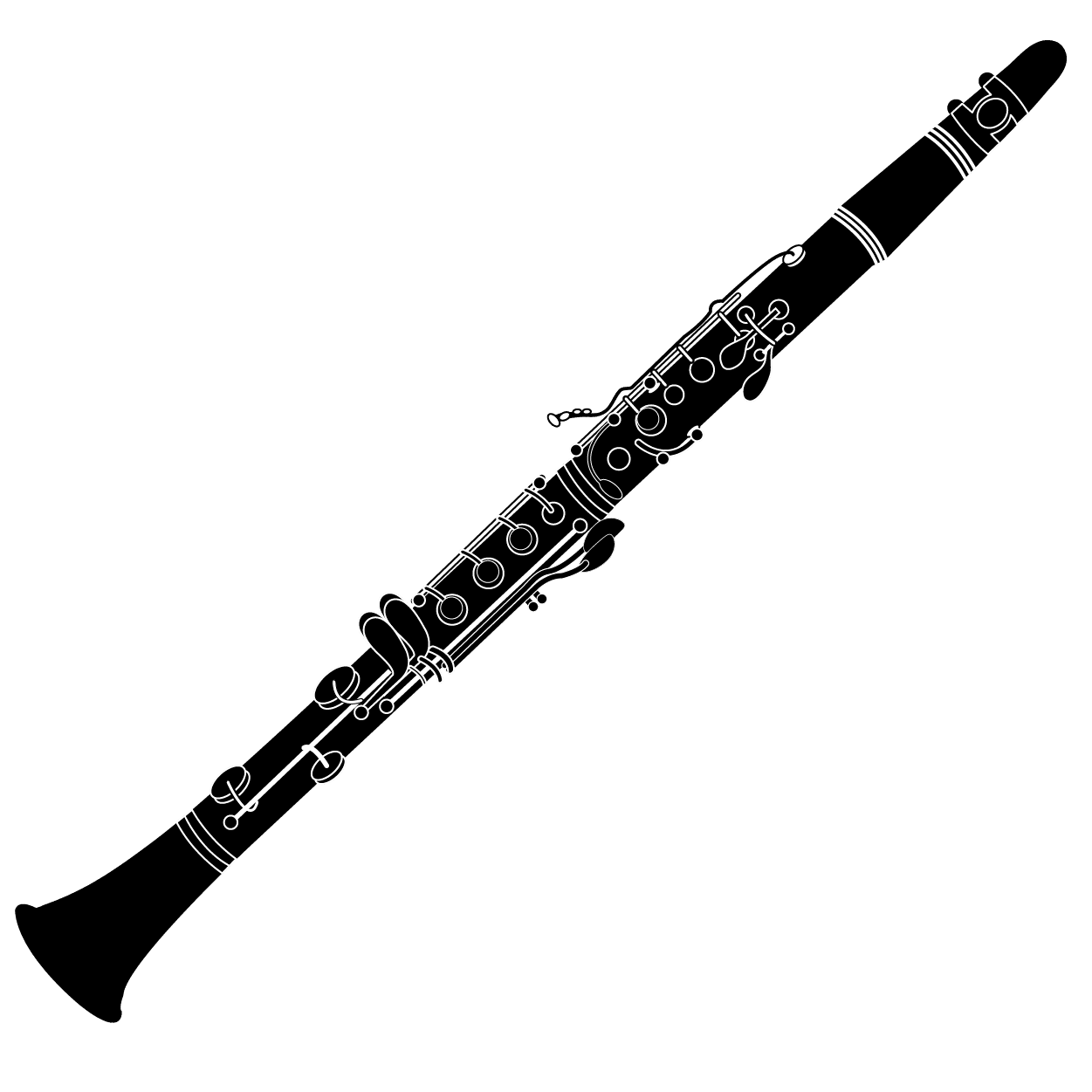
Clarinet Bb (chalumeau) and piano
Arranged by Frédéric CELLIER
Duration ≃ 01:50 | Difficulty ≃ 1/10
$ 3.99 Add
Add
SCORE Clarinet Bb (chalumeau) and piano
PDF - 2 pages
+
PART Clarinet Bb (chalumeau)
PDF - 1 page
+
BACKING TRACK
MP3 - 1 track
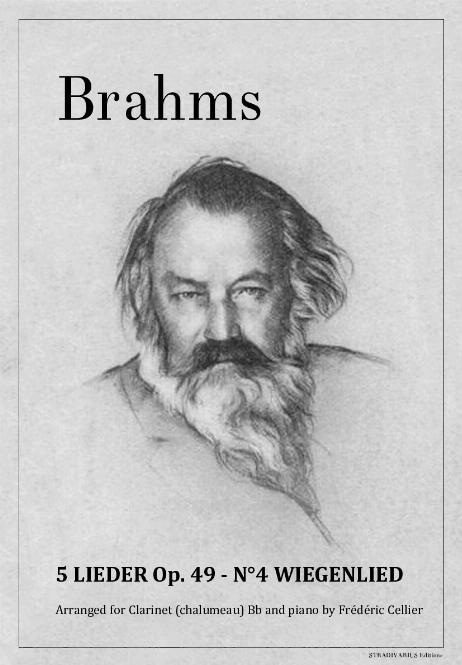
Sandmännchen is the fourth number in the collection of fifteen Volkskinderlieder, WoO 31, composed by Johannes Brahms in 1857.
It is based on an authentic traditional song inspired by the character of the Sandmann, a figure from German folklore who puts children to sleep by throwing magic sand into their eyes.
Die Blümelein sie schlafen
schon längst im Mondenschein,
sie nicken mit den Köpfen
auf ihren Stengelein.
Es rüttelt sich der Blütenbaum,
es säuselt wie im Traum:
Schlafe, schlafe,
schlaf du, mein Kindelein!
Die Vögelein, sie sangen
so süß im Sonnenschein,
sie sind zur Ruh gegangen
in ihre Nestchen klein.
Das Heimchen in dem Ährengrund,
es tut allein sich kund:
Schlafe, schlafe,
schlaf du, mein Kindelein!
Sandmännchen kommt geschlichen
und guckt durchs Fensterlein,
ob irgend noch ein Liebchen
nicht mag zu Bette sein.
Und wo er nur ein Kindchen fand,
streut er ins Aug' ihm Sand.
Schlafe, schlafe,
schlaf du, mein Kindelein!
Sandmännchen aus dem Zimmer,
Es schläft mein Herzchen fein,
Es ist gar fest verschlossen
Schon sein Guckäugelein.
Es leuchtet morgen mir; willkomm
das Äugelein so fromm!
Schlafe, schlafe,
schlaf du, mein Kindelein!
[The flowers have been sleeping
For a long time in the moonlight,
They nod their heads
On their little stems.
The blossoming tree rustles,
It whispers as if in a dream:
Sleep, sleep,
Sleep, my little one.
The little birds sang
So softly in the sunshine,
Now they have gone to rest
In their little nests.
The cricket, in the wheat grass,
Sings its song alone:
Sleep, sleep,
Sleep, my little one.
The sandman arrives surreptitiously
And looks through the window
To see if a loved one
Has not gone to bed.
And when he finds only one child,
He sprinkles sand in their eyes.
Sleep, sleep,
Sleep, my little one.
The sandman has left the room,
My dear little one is sleeping soundly,
Even their little eyes
Are tightly closed.
They will shine for me tomorrow; good morning,
Innocent little eyes.
Sleep, sleep,
Sleep, my little one.]
This lullaby exudes a peaceful and comforting atmosphere. The melody, simple but melodious, is supported by a discreet and regular piano accompaniment, reminiscent of the slow and peaceful movement of breathing before sleep.
It shines with the delicacy and modest tenderness of Brahms' writing, conveying a deep but restrained emotion.
Frédéric Cellier
Johannes Brahms was born on May 7, 1833, in Hamburg, Germany, into a modest family: his father was a café musician and instilled in him a love of music at an early age. A child prodigy, he studied piano and composition, quickly showing exceptional talent for melody and harmony. His youth was marked by rigor, study, and the influence of the great classical and romantic composers, notably Beethoven, Schumann, and Bach.
Brahms moved to Vienna in 1862, where he would remain for most of his life. There he met Robert and Clara Schumann, whose support and friendship played a decisive role in his career. He distinguished himself early on as a composer and virtuoso pianist, but refused to write opera, preferring to devote himself to symphonies, chamber music, lieder, and solo piano.
His major works include four symphonies, piano and violin concertos, song cycles, and numerous chamber music pieces. His style is characterized by contrapuntal rigor, harmonic richness, and profound expressiveness. Brahms succeeded in combining the classical tradition with romantic sensibility, creating music that is both intellectually structured and emotionally powerful.
Johannes Brahms died on April 3, 1897, in Vienna, leaving behind an immense legacy. He is considered one of the great masters of German Romanticism, whose music continues to fascinate with its depth, structural clarity, and timeless beauty. His work has had a lasting influence on symphonic composition, chamber music, and piano music for generations to come.
Along his university studies (DEA in musicology, University of Paris IV-Sorbonne), Frédéric Cellier was awarded three first prizes and a development prize at the CNR of Nice and won first prize at the International Competition of Musical Execution - soloist category – of Stresa (Italy).
He is the laureate of the Fondation de France and the Yehudi Menuhin Foundation and accredited teacher at the CNR of Nice, the CNR of Marseille, and at the CRR Olivier Messiaen of Avignon (France).
Frédéric Cellier is the interpreter of Francis Poulenc’s Sonata for clarinet Bb and piano with Jean-Michel Damase, Jean Françaix or Gabriel Tacchino, as well as his own arrangements for clarinet and harp of Erik Satie's Gymnopédies and Gnossiennes with the great French harpist Elizabeth Fontan-Binoche, and for clarinet, piano, and string orchestra of George Gershwin's Rhapsody in blue for Wynton Marsalis or under the baton of Adrian Gershwin, grandson of the composer.
Founder and artistic director of STRADIVARIUS Editions, he is the author of light music pieces played around the world and a considerable number of arrangements of all styles and for all instruments, acclaimed by many personalities in the music world, including Michèle Auric, Jean Françaix, Adrian Gershwin, Wynton Marsalis, Yehudi Menuhin, Madeleine Milhaud, Manuel Rosenthal, Gabriel Tacchino, and Ornella Volta.
"Frédéric Cellier has produced a number of adaptations of Georges Auric's works with such talent and precision that I consider them a natural addition to his chamber music catalogue."
Michèle AURIC - Georges Auric's widow
"To Frédéric Cellier, excellent musician and tireless arranger."
Jean FRANÇAIX - Composer and pianist
"Arranging a musical work is always a delicate and risky exercise, because it requires both modifying it so that it can be played by the desired instruments and preserving its very essence. But that is exactly what Frédéric Cellier has done, preserving the nuances, subtleties and soul of the original works while breathing new life into them.
His arrangements give all the musicians the chance to perform these compositions specially revisited for their instrument, and make music lovers rediscover them in a new light."
Adrian GERSHWIN - George Gershwin’s grandson
"Congratulations for your beautiful new orchestration and rendition of Gershwin’s Rhapsody in blue."
Wynton MARSALIS - Trumpet player, composer, bandleader, general and artistic director of Jazz at Lincoln Center, New York
"It is outstanding that Frédéric Cellier has managed to transpose Saxophone Marmalade from the saxophone to the clarinet. I thank him for it and wish its great and deserved success. "
Manuel ROSENTHAL - Conductor, composer and Maurice Ravel’s pupil
"I am very happy to tell you how much I appreciated your transcription of the Capriccio, based on Francis Poulenc's Le Bal Masqué. It perfectly reflects the spirit and verve of the score for two pianos that I had the opportunity to play and record with Jacques Février, and it was a great pleasure for me to premiere it in Montpellier."
Gabriel TACCHINO - Pianist, Francis Poulenc’s specialist
"I must tell you that I really like your transcriptions and that I think the tone of the instruments you have chosen suits perfectly our beloved composer."
Ornella VOLTA - Musicologist, president of the Erik Satie’s Foundation






Added to your basket
Removed from your basket
Added to your favorites
Removed from your favorites
You must be registered to use this function
You reached the download limit for free products (5 per day)






















 - SCORE Clarinet Bb (chalumeau) and piano)