



- Voice
- Keyboard
- String
- Woodwind
- Brass
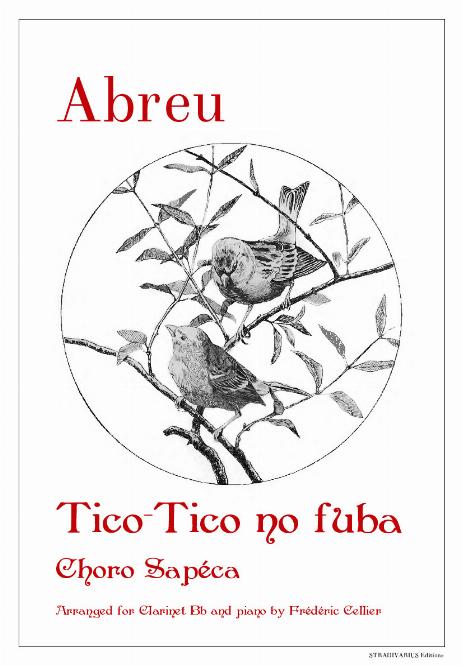 $ 4.99






Chôro sapéca
1917
Clarinet Bb and piano
Arranged by Frédéric CELLIER
Duration ≃ 02:10 | Difficulty ≃ 8/10
$ 4.99 Add
Add
SCORE Clarinet Bb and piano
PDF - 6 pages
+
PART PART Clarinet Bb
PDF - 4 pages
Tico-Tico or Tico-Tico no Farelo or Tico-Tico no Fubá is a Brazilian choro song composed by Zequinha de Abreu in 1917 and first recorded in 1931 by Orquestra Colbaz.
The original title ‘Tico-Tico no Farelo’ [sparrow in the sound in Brazilian Portuguese] was changed in 1931 to ‘Tico-Tico no Fubá’ [sparrow in cornmeal] because the Brazilian guitarist Canhoto had already written a work of the same title.
José Gomes de Abreu, better known by his nickname Zequinha de Abreu, was born on September 19, 1880, in Santa Rita do Passa Quatro, a small town in the interior of the state of São Paulo. Coming from a modest background, he grew up in a Brazil undergoing profound change, where popular music was beginning to assert itself as an essential marker of national identity. From an early age, Zequinha showed a particular sensitivity to sounds and rhythms. He taught himself to play the piano, developing a personal style nourished by both European tradition and Brazilian popular musical expressions.
His career took shape far from the major cultural centers, in local cinemas, dance halls, and orchestras, where he worked as a pianist and conductor. This closeness to the people had a profound influence on his musical writing. Zequinha de Abreu composed choros, maxixes, valsas, and Brazilian tangos, genres that reflect the liveliness, humor, and sometimes melancholy of everyday life. His music, accessible yet refined, demonstrates a keen sense of melody and rhythm.
In 1917, he composed “Tico-Tico no Fubá,” a work that would become emblematic of Brazilian music. This choro, both light and virtuosic, quickly crossed Brazil's borders to achieve international success. The piece embodies the spirit of Zequinha de Abreu: lively, joyful music deeply rooted in popular culture.
Through his ability to transform popular music forms into timeless works, Zequinha de Abreu is now considered one of the most influential composers in the history of Brazilian popular music.
Along his university studies (DEA in musicology, University of Paris IV-Sorbonne), Frédéric Cellier was awarded three first prizes and a development prize at the CNR of Nice and won first prize at the International Competition of Musical Execution - soloist category – of Stresa (Italy).
He is the laureate of the Fondation de France and the Yehudi Menuhin Foundation and accredited teacher at the CNR of Nice, the CNR of Marseille, and at the CRR Olivier Messiaen of Avignon (France).
Frédéric Cellier is the interpreter of Francis Poulenc’s Sonata for clarinet Bb and piano with Jean-Michel Damase, Jean Françaix or Gabriel Tacchino, as well as his own arrangements for clarinet and harp of Erik Satie's Gymnopédies and Gnossiennes with the great French harpist Elizabeth Fontan-Binoche, and for clarinet, piano, and string orchestra of George Gershwin's Rhapsody in blue for Wynton Marsalis or under the baton of Adrian Gershwin, grandson of the composer.
Founder and artistic director of STRADIVARIUS Editions, he is the author of light music pieces played around the world and a considerable number of arrangements of all styles and for all instruments, acclaimed by many personalities in the music world, including Michèle Auric, Jean Françaix, Adrian Gershwin, Wynton Marsalis, Yehudi Menuhin, Madeleine Milhaud, Manuel Rosenthal, Gabriel Tacchino, and Ornella Volta.
"Frédéric Cellier has produced a number of adaptations of Georges Auric's works with such talent and precision that I consider them a natural addition to his chamber music catalogue."
Michèle AURIC - Georges Auric's widow
"To Frédéric Cellier, excellent musician and tireless arranger."
Jean FRANÇAIX - Composer and pianist
"Arranging a musical work is always a delicate and risky exercise, because it requires both modifying it so that it can be played by the desired instruments and preserving its very essence. But that is exactly what Frédéric Cellier has done, preserving the nuances, subtleties and soul of the original works while breathing new life into them.
His arrangements give all the musicians the chance to perform these compositions specially revisited for their instrument, and make music lovers rediscover them in a new light."
Adrian GERSHWIN - George Gershwin’s grandson
"Congratulations for your beautiful new orchestration and rendition of Gershwin’s Rhapsody in blue."
Wynton MARSALIS - Trumpet player, composer, bandleader, general and artistic director of Jazz at Lincoln Center, New York
"It is outstanding that Frédéric Cellier has managed to transpose Saxophone Marmalade from the saxophone to the clarinet. I thank him for it and wish its great and deserved success. "
Manuel ROSENTHAL - Conductor, composer and Maurice Ravel’s pupil
"I am very happy to tell you how much I appreciated your transcription of the Capriccio, based on Francis Poulenc's Le Bal Masqué. It perfectly reflects the spirit and verve of the score for two pianos that I had the opportunity to play and record with Jacques Février, and it was a great pleasure for me to premiere it in Montpellier."
Gabriel TACCHINO - Pianist, Francis Poulenc’s specialist
"I must tell you that I really like your transcriptions and that I think the tone of the instruments you have chosen suits perfectly our beloved composer."
Ornella VOLTA - Musicologist, president of the Erik Satie’s Foundation


Added to your basket
Removed from your basket
Added to your favorites
Removed from your favorites
You must be registered to use this function
You reached the download limit for free products (5 per day)