



- Voice
- Keyboard
- String
- Woodwind
- Brass
 $ 1.99


 - SCORE 2 Clarinets (chalumeau) )



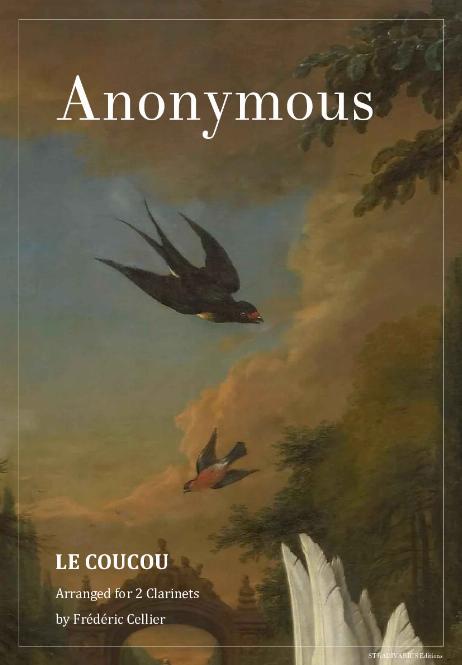
N°4 Menuet
1727
2 Clarinets (chalumeau)
Arranged by Frédéric CELLIER
Duration ≃ 01:05 | Difficulty ≃ 1/10
$ 1.99 Add
Add
SCORE 2 Clarinets (chalumeau)
PDF - 2 pages
The two voices of this Minuet are limited to the lower register of the clarinet, known as the chalumeau.
The first part is built on an ascending and descending scale from C to G, while the second part transposes this formula into the lower register from G to C - making it an excellent support for the study of C major.
Despite this simple form, the contrapuntal shift makes this duet a pleasure to listen to and study. As well as producing obvious musical pleasure, this shift encourages independence, listening and imitation of the teacher by the student.
Joseph Bodin de Boismortier (1689–1755) was one of the most original and independent figures in 18th-century French music. A prolific composer, independent thinker, and entrepreneur ahead of his time, he embodied a new status for musicians, free from exclusive service to a court or patron.
Born on December 23, 1689, in Thionville, then part of the Kingdom of France, Boismortier received a solid musical education, though details of his training are not entirely documented. Settling in Paris in the 1720s, he benefited from a favorable environment: the rise of music publishing and the bourgeois public's enthusiasm for amateur music-making. In 1724, he obtained a royal publishing privilege, which allowed him to publish and sell his works independently—an exceptional feat for the time.
Boismortier composed with remarkable prolificacy: more than 100 opuses, covering a wide variety of genres. He wrote for many instruments—transverse flute, musette, viola, bassoon, harpsichord—and distinguished himself by his constant concern for clarity, accessibility, and immediate pleasure. His music, often intended for enlightened amateurs, favored melody, dance, and formal balance.
Although he excelled in instrumental music, Boismortier also tried his hand at opera. His opera-ballet Don Quichotte chez la Duchesse (1743) reveals a keen sense of theater and humor. However, his popular success sometimes earned him the contempt of academic circles, who criticized his writing as being too simple.
Proud of his independence, Boismortier ironically claimed credit for his commercial success, declaring that he wrote “to earn money,” a rare and provocative statement at a time when artists were expected to display a disinterested ideal. He retired comfortably from business around 1753 and died in Roissy-en-Brie on October 28, 1755.
Joseph Bodin de Boismortier leaves behind the image of a modern composer ahead of his time, attentive to his audience and a master of a clear and elegant art. Long underestimated, he is now being rediscovered as an essential figure in French musical life during the Enlightenment.
Along his university studies (DEA in musicology, University of Paris IV-Sorbonne), Frédéric Cellier was awarded three first prizes and a development prize at the CNR of Nice and won first prize at the International Competition of Musical Execution - soloist category – of Stresa (Italy).
He is the laureate of the Fondation de France and the Yehudi Menuhin Foundation and accredited teacher at the CNR of Nice, the CNR of Marseille, and at the CRR Olivier Messiaen of Avignon (France).
Frédéric Cellier is the interpreter of Francis Poulenc’s Sonata for clarinet Bb and piano with Jean-Michel Damase, Jean Françaix or Gabriel Tacchino, as well as his own arrangements for clarinet and harp of Erik Satie's Gymnopédies and Gnossiennes with the great French harpist Elizabeth Fontan-Binoche, and for clarinet, piano, and string orchestra of George Gershwin's Rhapsody in blue for Wynton Marsalis or under the baton of Adrian Gershwin, grandson of the composer.
Founder and artistic director of STRADIVARIUS Editions, he is the author of light music pieces played around the world and a considerable number of arrangements of all styles and for all instruments, acclaimed by many personalities in the music world, including Michèle Auric, Jean Françaix, Adrian Gershwin, Wynton Marsalis, Yehudi Menuhin, Madeleine Milhaud, Manuel Rosenthal, Gabriel Tacchino, and Ornella Volta.
"Frédéric Cellier has produced a number of adaptations of Georges Auric's works with such talent and precision that I consider them a natural addition to his chamber music catalogue."
Michèle AURIC - Georges Auric's widow
"To Frédéric Cellier, excellent musician and tireless arranger."
Jean FRANÇAIX - Composer and pianist
"Arranging a musical work is always a delicate and risky exercise, because it requires both modifying it so that it can be played by the desired instruments and preserving its very essence. But that is exactly what Frédéric Cellier has done, preserving the nuances, subtleties and soul of the original works while breathing new life into them.
His arrangements give all the musicians the chance to perform these compositions specially revisited for their instrument, and make music lovers rediscover them in a new light."
Adrian GERSHWIN - George Gershwin’s grandson
"Congratulations for your beautiful new orchestration and rendition of Gershwin’s Rhapsody in blue."
Wynton MARSALIS - Trumpet player, composer, bandleader, general and artistic director of Jazz at Lincoln Center, New York
"It is outstanding that Frédéric Cellier has managed to transpose Saxophone Marmalade from the saxophone to the clarinet. I thank him for it and wish its great and deserved success. "
Manuel ROSENTHAL - Conductor, composer and Maurice Ravel’s pupil
"I am very happy to tell you how much I appreciated your transcription of the Capriccio, based on Francis Poulenc's Le Bal Masqué. It perfectly reflects the spirit and verve of the score for two pianos that I had the opportunity to play and record with Jacques Février, and it was a great pleasure for me to premiere it in Montpellier."
Gabriel TACCHINO - Pianist, Francis Poulenc’s specialist
"I must tell you that I really like your transcriptions and that I think the tone of the instruments you have chosen suits perfectly our beloved composer."
Ornella VOLTA - Musicologist, president of the Erik Satie’s Foundation


Added to your basket
Removed from your basket
Added to your favorites
Removed from your favorites
You must be registered to use this function
You reached the download limit for free products (5 per day)